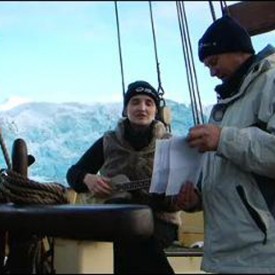




Most evenings, we have a lecture from one of the scientists or artists explaining their profession and the reason for being on this expedition. Debora Iglesias-Rodriguez gave us a very interesting presentation on ocean acidification.
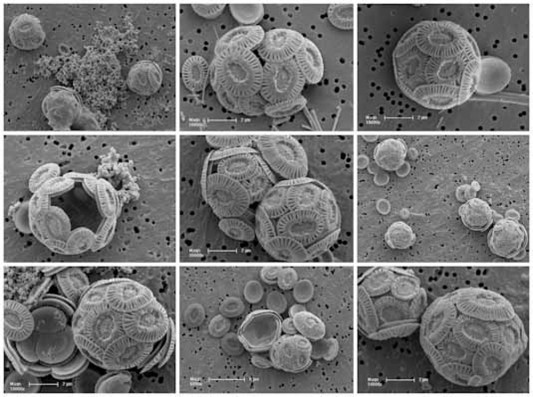
Debora studies microscopic plant cells called coccolithophores. They produce tiny platelets termed coccoliths that accumulate on the sediment and represent one of the largest carbon reservoirs on Earth. Invisible to the eye, these cells control large scale processes that maintain the carbon balance in the Earth.
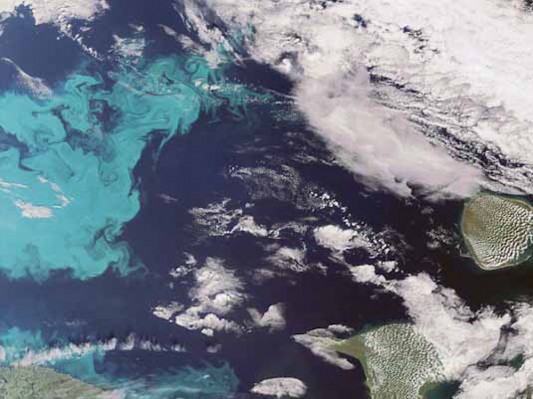
The coccolithophore blooms can be seen from outer space so Debora uses both satellites and scanning electron microscopy in order to understand how the huge populations or blooms change in space and time, and how climate change is affecting the production of coccoliths. Her research focusses on the evolution of these and other chalk producing animals and plants and how changes in these populations can affect the global carbon cycle. This results in some very beautiful imagery.